Why don't we remember our past lives?
Why do innocent children suffer? Why can't we remember our past lives? This article explores these timeless questions through logic and the teachings of the Bhagavad Gita and Srimad Bhagavatam.
BLOGS
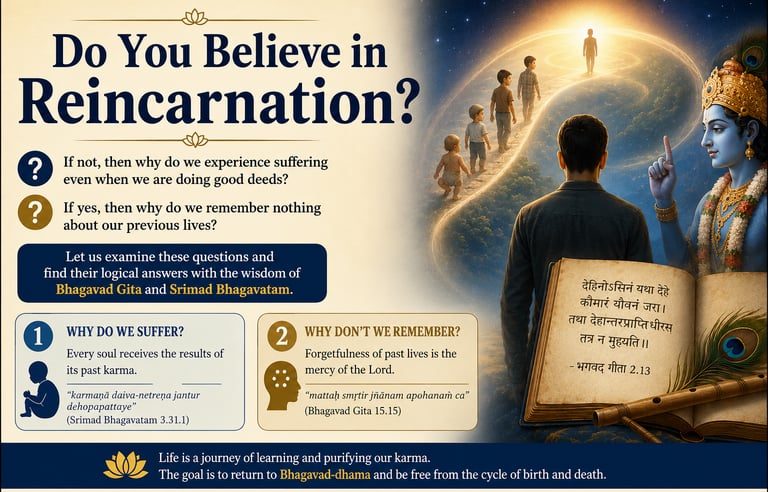
Do You Believe in Reincarnation?
There can be only two answers to this question—Yes or No. However, both answers give rise to another logical question. Let us examine these two questions and try to find their answers.
If not, then why do we experience suffering even when we are doing good deeds?
If yes, then why do we remember nothing about our previous lives?
Question 1:
If reincarnation does not exist, then why do we suffer?
Answer
You may have seen or heard about a small child suffering from a fatal disease, meeting with a terrible accident, or becoming an orphan at a very young age.
How should we understand such situations?
The child is still very young. He has not even learned to speak properly. How could he have committed any sinful or immoral act? And if he is incapable of committing sin, then why is he experiencing such severe suffering?
Is someone testing him?
Even if we assume that someone is testing him, then why is his examination paper so difficult? If there is no valid reason behind giving such a painful test, then we would have to conclude that the examiner is either insane or a cruel being who is inflicting suffering merely for his own amusement. Such an explanation is neither logical nor satisfying.
However, if we say that these are the results of the child's actions from a previous life, which he had not yet experienced, then the situation begins to make logical sense.
Perhaps in his previous life, he caused suffering to another child of a similar age. Now the time has come for him to experience the consequences of those actions.
The law of nature does not work like a bank account where we perform five pious deeds and two sinful deeds, leaving us with a net balance of three pious deeds.
No.
Nature's law is that we must experience the results of all five pious deeds as well as the consequences of all two sinful deeds. Every action produces its own result.
Bhagavad Gita 4.17
gahanā karmaṇo gatiḥ
"The path of karma is very difficult to understand."
This verse reminds us that the workings of karma are extremely subtle. We often see only the present event, but we do not know the actions performed in previous lives that may have led to it.
Śrīmad Bhāgavatam 3.31.1
karmaṇā daiva-netreṇa jantur dehopapattaye
striyāḥ praviṣṭa udaraṁ puṁso retaḥ-kaṇāśrayaḥ
Translation:
"Under the supervision of the Supreme Lord and according to the results of his own karma, the living entity enters the womb of a mother to receive another material body."
This verse explains that birth itself is determined according to one's previous karma. Therefore, the circumstances in which a person is born are not random but are connected to actions performed in previous lives.
Certainly, when we see such a child suffering, compassion and sympathy naturally arise within us. This is completely natural, and such compassion should indeed arise.
In reality, we should not feel compassion only for the child who is presently suffering the consequences of his past sins, but also for the child against whom he committed those sinful acts in his previous life.
Thus, through this line of reasoning, we can understand that the principle of reincarnation is a logical reality.
Question 2:
If previous lives are real, then why do we remember nothing about them?
Answer
Let us suppose, for a moment, that you suddenly remembered everything about your previous life.
Suppose you remembered that in your previous birth you were a woman, and after your death, your husband remarried.
In this present life, you have taken birth in a wealthy and respected family, and you have a bright future ahead of you. However, because you remember everything from your previous life, you are unable to develop a natural relationship with your present family.
Instead, you wish to meet your husband from your previous life, who no longer recognizes you.
In such a situation, you would end up destroying not only your present family but also his family.
The karma of your previous life comes to an end with your death, and a completely new chapter begins with your next birth.
Bhagavad Gita 2.13
dehino 'smin yathā dehe
kaumāraṁ yauvanaṁ jarā
tathā dehāntara-prāptir
Translation:
"Just as the embodied soul continuously passes, in this body, from childhood to youth to old age, the soul similarly passes into another body at death. A sober person is not bewildered by such a change."
This verse establishes that the soul continues its journey by accepting another body after death.
Bhagavad Gita 15.8
śarīraṁ yad avāpnoti
yac cāpy utkrāmatīśvaraḥ
gṛhītvaitāni saṁyāti
vāyur gandhān ivāśayāt
Translation:
"As the air carries fragrances from one place to another, the living entity carries his mind and senses from one body to another."
Although the soul carries subtle impressions (saṁskāras) from one life to the next, our gross memories do not accompany us.
Forgetting our previous lives is one of the greatest mercies bestowed upon us by the Supreme Lord through His material nature.
It is like a reset button that erases all previous memories and renews our software.
It gives us the opportunity to make a fresh beginning in a new life.
Bhagavad Gita 15.15
sarvasya cāhaṁ hṛdi sanniviṣṭo
mattaḥ smṛtir jñānam apohanaṁ ca
Translation:
"I am seated in everyone's heart, and from Me come remembrance, knowledge, and forgetfulness."
This verse explains that remembrance and forgetfulness are both arranged by the Supreme Lord. Therefore, our inability to remember previous lives is not a defect but part of the Lord's arrangement for our journey through material existence.
However, until all of our sinful and pious reactions have been completely exhausted, we cannot return to Bhagavad-dhama.
Bhagavad Gita 8.15
mām upetya punar janma
duḥkhālayam aśāśvatam
nāpnuvanti mahātmānaḥ
saṁsiddhiṁ paramāṁ gatāḥ
Translation:
"After attaining Me, the great souls never return to this temporary world of misery, for they have achieved the highest perfection."
This verse confirms that the cycle of repeated birth and death ends only when one attains the Supreme Lord.
Hare Krishna!
→ All Articles
© Copyright 2026 | www.onlinegdas.in | All Rights Reserved
Hare Kṛṣṇa, Hare Kṛṣṇa, Kṛṣṇa Kṛṣṇa, Hare Hare | Hare Rāma, Hare Rāma, Rāma Rāma, Hare Hare ||