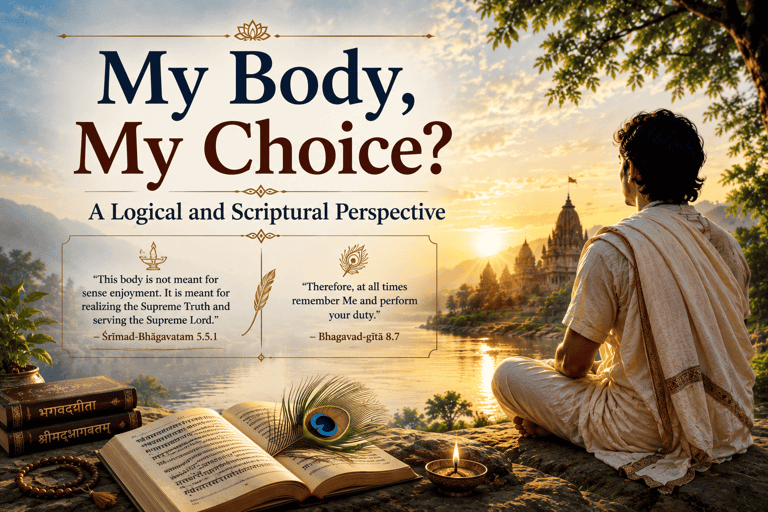
My Body My Choice? A Logical and Scriptural Perspective
My Body My Choice? Is the human body truly ours to use however we wish? Explore a logical conversation supported by the Bhagavad Gita and Srimad Bhagavatam to understand the real purpose of the human body.
BLOGS
Is This Really My Body? A Logical Conversation That Changed the Perspective
After the COVID-19 pandemic, when offices reopened, all employees were asked to work from the office for at least eight days every month. During that time, I often travelled to the office by carpooling with one of my colleagues.
He knew that I frequently spoke about spirituality and devotional life, so he often asked me questions on these subjects. One day, while we were driving to the office, he asked me a very interesting question.
He said, "Suppose I drink alcohol and return home after drinking, but I never harm anyone. I don't abuse or mistreat my family, nor do I create any disturbance. Am I really committing any sin? After all, alcohol is also made from the juice of fruits. Besides, this is my body. I should be free to do whatever I want with it. Why should God have any problem with that? If drinking causes harm, it is my own body that suffers. Then why should I incur sinful reactions?"
My colleague was a very logical person. Whenever I quoted scriptural evidence, he would simply say, "I want a logical answer that I can understand."
His question was not really about alcohol. Alcohol was merely an example. The real question was whether the idea "This is my body, and I can use it however I like" is actually correct.
This same line of thinking is often used to justify many different actions. Therefore, it is important to first examine whether the foundation of this belief is true.
Instead of answering him directly, I asked him a few questions. Sometimes, the best way to answer a question is by asking a few thoughtful questions in return. Such questions often help a person arrive at the answer on their own.
I asked him:
If this is truly your body, then how much control do you actually have over it?
If this is your body, can you stop your hair and nails from growing?
If this is your body, can you stop yourself from growing old?
If this is your body, why does it become diseased even when you do not want it to?
If this body truly belongs to you, then why does it leave you at the time of death?
Instead of answering these questions, he asked me, "If this is not my body, then whose body is it?"
I replied, "Certainly, this body has been entrusted to you, and in that sense it is yours. But the real question is not ownership—it is control. You may use the body, but you cannot claim absolute control over it."
The Bhagavad-gītā explains that the living being desires to control material nature, but is actually controlled by it:
"The living entities in this conditioned world are My eternal fragmental parts. Due to conditioned life, they are struggling very hard with the six senses, including the mind."
— Bhagavad-gītā 15.7
(mamaivāṁśo jīva-loke jīva-bhūtaḥ sanātanaḥ manaḥ-ṣaṣṭhānīndriyāṇi prakṛti-sthāni karṣati)
Similarly, Lord Krishna explains that everyone acts under the influence of material nature:
"All activities are carried out by the modes of material nature, but one whose mind is bewildered by false ego thinks, 'I am the doer.'"
— Bhagavad-gītā 3.27
(prakṛteḥ kriyamāṇāni guṇaiḥ karmāṇi sarvaśaḥ ahaṅkāra-vimūḍhātmā kartāham iti manyate)
If we are unable to control our own body, then we should honestly ask ourselves: Who is controlling it?
If this body is ultimately governed by material nature, and material nature itself works under the direction of the Supreme Lord, then only the Supreme Lord can reveal the true purpose of this body.
The Bhagavad-gītā confirms this:
"This material nature, which is one of My energies, is working under My supervision and is producing all moving and non-moving beings."
— Bhagavad-gītā 9.10
(mayādhyakṣeṇa prakṛtiḥ sūyate sa-carācaram)
The Śrīmad-Bhāgavatam also reminds us that the human body is a rare gift meant for spiritual realisation, not merely for sense enjoyment:
"This human form of life is not meant for working hard simply for sense gratification like the animals. Rather, it is meant for performing divine austerity, by which one's existence becomes purified and one attains unlimited spiritual happiness."
— Śrīmad-Bhāgavatam 5.5.1
(nāyaṁ deho deha-bhājāṁ nṛloke kaṣṭān kāmān arhate vid-bhujāṁ ye...)
Finally, I told my colleague:
"Now that you have received a logical answer, let me tell you what the scriptures say. This human body has actually been given to us for the service of Lord Krishna. That is the highest and most meaningful use of this body. Only by engaging this body in His service can we experience lasting happiness."
Otherwise, this body is naturally designed to experience suffering, not permanent happiness.
Consider a simple example. Suppose you are sitting very comfortably on a chair. After some time, the same comfortable position begins to feel uncomfortable, and you are forced to change your posture. This shows that material comfort is temporary because the body itself is temporary.
Lord Krishna therefore advises us:
"Therefore, at all times remember Me and perform your prescribed duty. With your mind and intelligence fixed on Me, you will surely come to Me."
— Bhagavad-gītā 8.7
(tasmāt sarveṣu kāleṣu mām anusmara yudhya ca mayy arpita-mano-buddhir mām evaiṣyasy asaṁśayaḥ)
This body can be taken away from us at any moment. Therefore, let us not waste this rare opportunity. Let us always remember Lord Krishna and engage this body in His loving service. That alone is the true purpose of human life.
"One who understands the transcendental nature of My appearance and activities does not, upon leaving the body, take birth again in this material world, but attains My eternal abode, O Arjuna."
— Bhagavad Gītā 4.9
(janma karma ca me divyam evaṁ yo vetti tattvataḥ, tyaktvā dehaṁ punar janma naiti mām eti so 'rjuna)
Hare Krishna!
© Copyright 2026 | www.onlinegdas.in | All Rights Reserved
Hare Kṛṣṇa, Hare Kṛṣṇa, Kṛṣṇa Kṛṣṇa, Hare Hare | Hare Rāma, Hare Rāma, Rāma Rāma, Hare Hare ||