How Is Our Next Birth Determined?
How is our next birth determined? Discover how the Bhagavad Gita explains what determines our next birth, the importance of our final thoughts, and how devotion leads to the Lord's eternal abode.
BLOGS
How Is Our Next Birth Determined?
In the previous article, we discussed that rebirth is real and understood it through both logic and the scriptures.
Today, we will discuss how our next birth is determined. Do the scriptures also tell us where our next birth will take place and what kind of body we will receive? The answer is yes. The Vedic scriptures clearly explain the principles that determine our next birth.
The Bhagavad-gītā explains that whatever occupies our consciousness at the time of death determines the nature of our next birth:
"Whatever state of being one remembers when he quits his body, O son of Kuntī, that state he will attain without fail."
— Bhagavad-gītā 8.6
(yaṁ yaṁ vāpi smaran bhāvaṁ tyajaty ante kalevaram taṁ tam evaiti kaunteya sadā tad-bhāva-bhāvitaḥ)
The scriptures also explain that the desires left unfulfilled in this lifetime are fulfilled by awarding us a body suitable for fulfilling those very desires in the next life.
There are many examples of this principle in the scriptures. One of the most well-known is the story of Maharaja Bharata, described in the Śrīmad Bhāgavatam (Cantos 5.7–5.14).
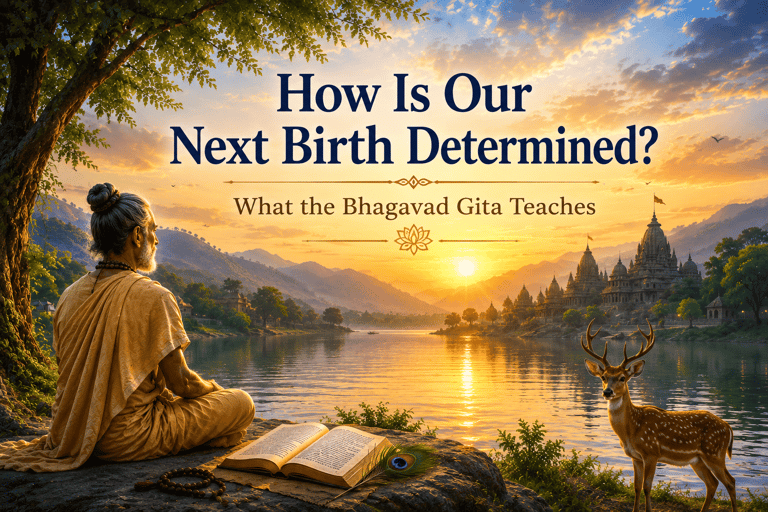
At the end of his life, Maharaja Bharata became absorbed in thoughts of a young deer. Consequently, he was born as a deer in his next life. Although he was a pure devotee with no material desires, he retained the memory of his previous life even while living in the body of a deer. After giving up that body, he took birth again as a human and became famous as Jada Bharata. In that life, he continued his devotional service with great determination and ultimately attained the eternal abode of the Supreme Lord.
Someone may now ask, "Then isn't it very easy? Simply remember the Lord at the time of death and attain His eternal abode."
The answer is both yes and no.
Yes, because the Lord Himself declares:
"And whoever, at the end of life, quits his body remembering Me alone attains My nature. Of this there is no doubt."
— Bhagavad-gītā 8.5
(anta-kāle ca mām eva smaran muktvā kalevaram yaḥ prayāti sa mad-bhāvaṁ yāti nāsty atra saṁśayaḥ)
Therefore, one who perfects devotional service during this lifetime becomes qualified to attain the Lord's abode. However, remembering the Lord at the final moment is absolutely essential.
The answer is also no, because due to the impressions (saṁskāras) carried from previous births and the unwanted habits and impurities (anarthas) accumulated in this life, a person often fails to make steady progress in devotional service. Instead, one remains attached throughout life to home, family, spouse, children, wealth, and possessions. Such attachments naturally occupy the mind at the final moment.
For this reason, Lord Krishna gives another important instruction:
"Therefore, always remember Me and at the same time perform your prescribed duty. With your mind and intelligence fixed on Me, you will surely come to Me."
— Bhagavad-gītā 8.7
(tasmāt sarveṣu kāleṣu mām anusmara yudhya ca mayy arpita-mano-buddhir mām evaiṣyasy asaṁśayaḥ)
This verse teaches us that remembrance of the Lord at the time of death is not something that can be achieved suddenly. It is the natural result of remembering Him throughout our lives while faithfully performing our responsibilities.
I do not mean that one should neglect one's family or children or fail to provide them with comfort and necessities. Rather, if a person also engages his family, spouse, wealth, and children in devotional service, then the journey toward attaining the Lord's abode becomes much easier.
The scriptures explain that when a devotee takes birth in a family, many generations benefit. This does not mean that everyone automatically attains liberation. Rather, the family members receive sukṛti (spiritual merit), which gives them the opportunity to take up devotional service, become free from the cycle of birth and death, and ultimately attain the Lord's eternal abode. Indeed, the appearance of a devotee in a family is itself a great mercy.
As mentioned earlier, we can understand the principle that determines our next birth. For example, if a boy spends this life strongly desiring to become a girl and leaves his body with that desire, he may receive the body of a woman in his next birth. Similarly, if one's consciousness at the time of death is completely absorbed in thoughts of a woman, such remembrance may also result in receiving a female body. This is simply an application of the universal principle stated in the Bhagavad-gītā.
Ultimately, the thoughts we repeatedly cultivate in this lifetime become the foundation of our next birth. Therefore, the safest and highest course is to cultivate constant remembrance of the Supreme Lord.
As Lord Krishna assures:
"For one who always remembers Me without deviation, I am easily attainable, O Pārtha, because he is constantly engaged in devotion."
— Bhagavad-gītā 8.14
(ananya-cetāḥ satataṁ yo māṁ smarati nityaśaḥ tasyāhaṁ sulabhaḥ pārtha nitya-yuktasya yoginaḥ)
If we sincerely practice remembering the Lord throughout our lives, then remembering Him at the final moment will come naturally. And by His mercy, we can attain His eternal abode and become free forever from the cycle of birth and death.
© Copyright 2026 | www.onlinegdas.in | All Rights Reserved
Hare Kṛṣṇa, Hare Kṛṣṇa, Kṛṣṇa Kṛṣṇa, Hare Hare | Hare Rāma, Hare Rāma, Rāma Rāma, Hare Hare ||