Agriculture, Cow Protection, and the True Purpose of Human Progress
The Vedic civilization was built upon agriculture and cow protection. This article explores how technological progress should not only save time but also inspire us to use that time for devotion and spiritual growth.
BLOGS
Agriculture, Cow Protection and the True Purpose of Human Progress
By studying the Vedic scriptures, we come to understand how people lived during the Vedic age, what their daily lives were like, and how they practiced Varnashrama Dharma.
One thing becomes very clear when we study the Vedic way of life: agriculture and cow protection (animal husbandry) occupied a central place in society.
In fact, it would not be incorrect to say that these were the two principal occupations of Vedic civilization—agriculture and cow protection. As time passed, many other important occupations and industries developed, but they all originated from these two foundations.
For example, agriculture gave rise to businesses and industries related to fruits, vegetables, grains, and many other agricultural products. Similarly, animal husbandry provided milk, from which numerous dairy-related businesses and industries emerged.
Other occupations, such as pottery, blacksmithing, carpentry, and various traditional crafts, also revolved around these two primary occupations. If we carefully observe the essential items that we use in our daily lives, we find that most of them ultimately originate from agriculture and animal husbandry.
These two activities—agriculture and animal husbandry—were based on a harmonious relationship between human beings and animals.
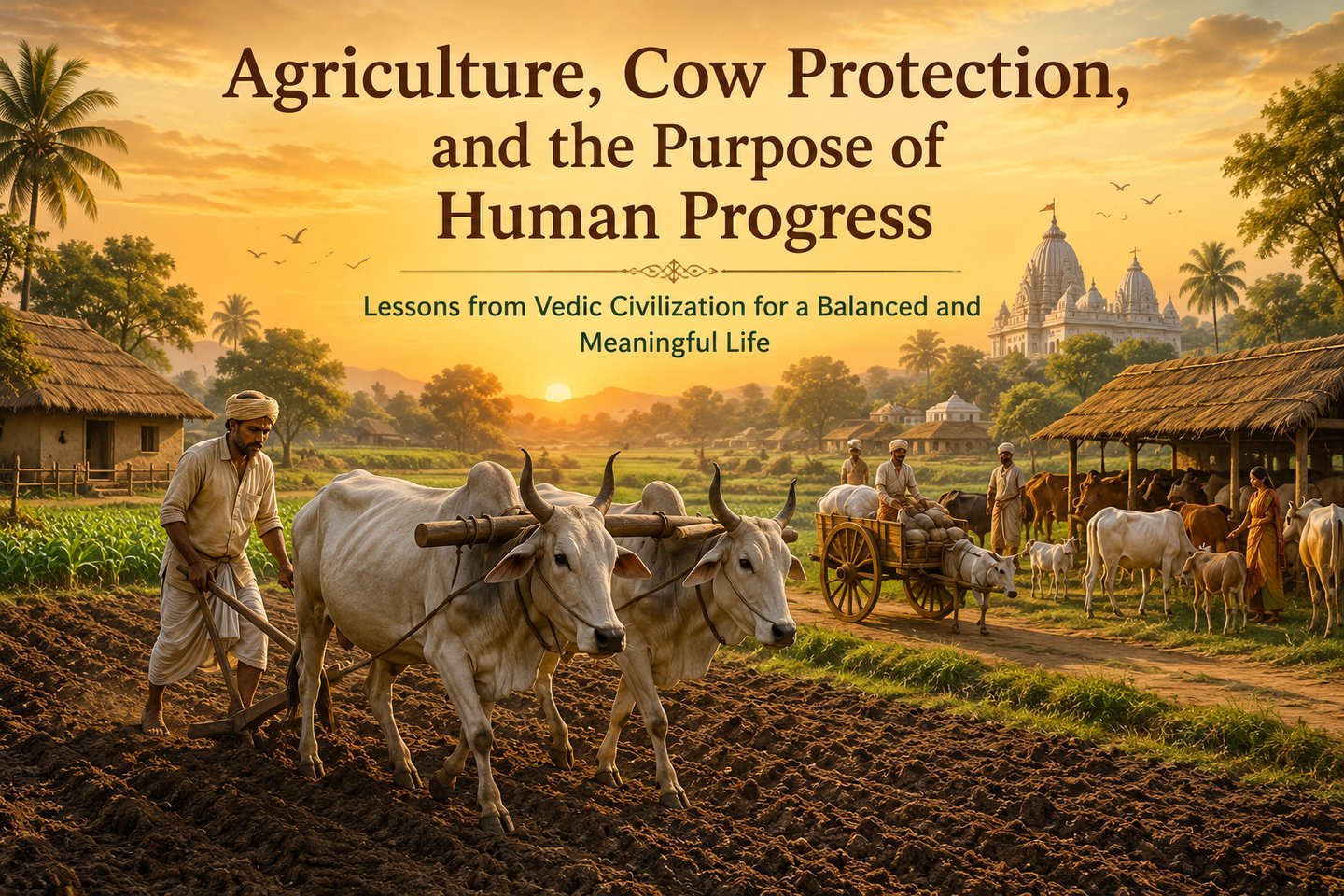
For example, during the Vedic age, oxen were used to plough the fields. In fact, even twenty or thirty years ago, I personally remember seeing farmers in my village cultivating their fields with the help of oxen.
Once the harvest was ready, the same oxen were harnessed to bullock carts to transport the grain to the marketplace. Even today, in some parts of Old Delhi, we can still see traditional bullock carts being used.
While working in this way, the oxen often appeared lean, but that did not mean they were unhealthy. Oxen are naturally meant to work. Meaningful work keeps their bodies active and healthy.
Today, however, we have largely replaced oxen in the fields with machines, especially tractors.
Progress is certainly a good thing, and we should continue to advance. However, whenever we introduce a change into our lives, we must also carefully consider its long-term consequences.
Today, we often see bulls wandering freely on the roads. These were once the very oxen that had worked alongside human beings in the fields since Vedic times. But after replacing them with machines, we gradually removed them from their natural role in society. They now roam the streets as stray bulls and, at times, even become the cause of road accidents.
The Vedic civilization teaches us how human beings can work in harmony with all living beings. Human society and animals existed in a mutually beneficial relationship, where each had a meaningful role to play. A machine-based civilization, however, often moves away from this natural harmony.
But an important question arises.
Why did we develop these machines in the first place?
The obvious answer is to save time.
However, my question is this:
How have we utilized the time that we have saved?
If that saved time has been used to increase our bhakti (devotional service), deepen our understanding of the Vedic scriptures, serve society, and strengthen our relationship with the Supreme Lord, then technological advancement has truly served its purpose. In that case, we have made proper use of both our time and our human life.
However, if the time saved has merely been used to increase our sense gratification, then we have only wasted that precious opportunity. In doing so, we have also disturbed the natural harmony established by the Supreme Lord, creating problems not only for ourselves but also for future generations.
At this point, it is important to understand that the purpose of this discussion is not to criticize technological advancement. Progress is beneficial, and every generation naturally develops better tools and methods to improve human life. The real question is how those advancements are used and whether they remain in harmony with the natural system established by the Lord.
This principle can also be understood by observing Lord Baladeva, who is always depicted carrying a plough (hala) in His hand.
A plough is also a tool used in agriculture. However, unlike many modern machines, it does not replace the oxen. Rather, it works together with them and makes them an essential part of the agricultural process.
This teaches us an important lesson.
Human innovation is not wrong in itself. The real question is whether our inventions assist the natural process or replace the living beings who are an integral part of that process.
As we continue to develop new technologies, we should ensure that they do not unnecessarily remove living beings from the roles that nature has designed for them. Instead, our inventions should work in harmony with the natural order.
The relationship between human beings, cows, and oxen has always been one of mutual dependence. Human society has cared for them, and in return they have supported human civilization in countless ways. This harmonious relationship is one of the beautiful characteristics of Vedic civilization.
Therefore, whenever we call something progress, we should not evaluate it solely by how much time, money, or labour it saves. We should also ask ourselves:
Does it preserve harmony with nature?
Does it encourage compassion toward all living beings?
Does it help us use our saved time in the service of the Supreme Lord?
If the answer is yes, then such progress is truly beneficial.
If not, then we should rethink whether we are advancing only materially while gradually moving away from the natural principles that have sustained human society for thousands of years.
The personal example of Lord Krishna & Lord Baladeva beautifully reinforces these principles. Lord Krishna is glorified as "Go-brāhmaṇa-hitāya"—the well-wisher of the cows and the brāhmaṇas.—while Lord Baladeva carries the plough (hala), reminding us that human progress should remain connected with the natural order established by the Supreme Lord.
The question, therefore, is not whether we should progress, but whether our progress is taking us closer to the Supreme Lord or further away from Him. If our advancement helps us cultivate bhakti while preserving the natural harmony established by the Lord, then it is true progress. Otherwise, we should pause and reflect on the direction in which we are moving.
© Copyright 2026 | www.onlinegdas.in | All Rights Reserved
Hare Kṛṣṇa, Hare Kṛṣṇa, Kṛṣṇa Kṛṣṇa, Hare Hare | Hare Rāma, Hare Rāma, Rāma Rāma, Hare Hare ||